

Categories
Full Circle PodcastPublished October 29, 2026
From Project Housing to University Leadership: Dr. Roberto Montoya's Full Circle

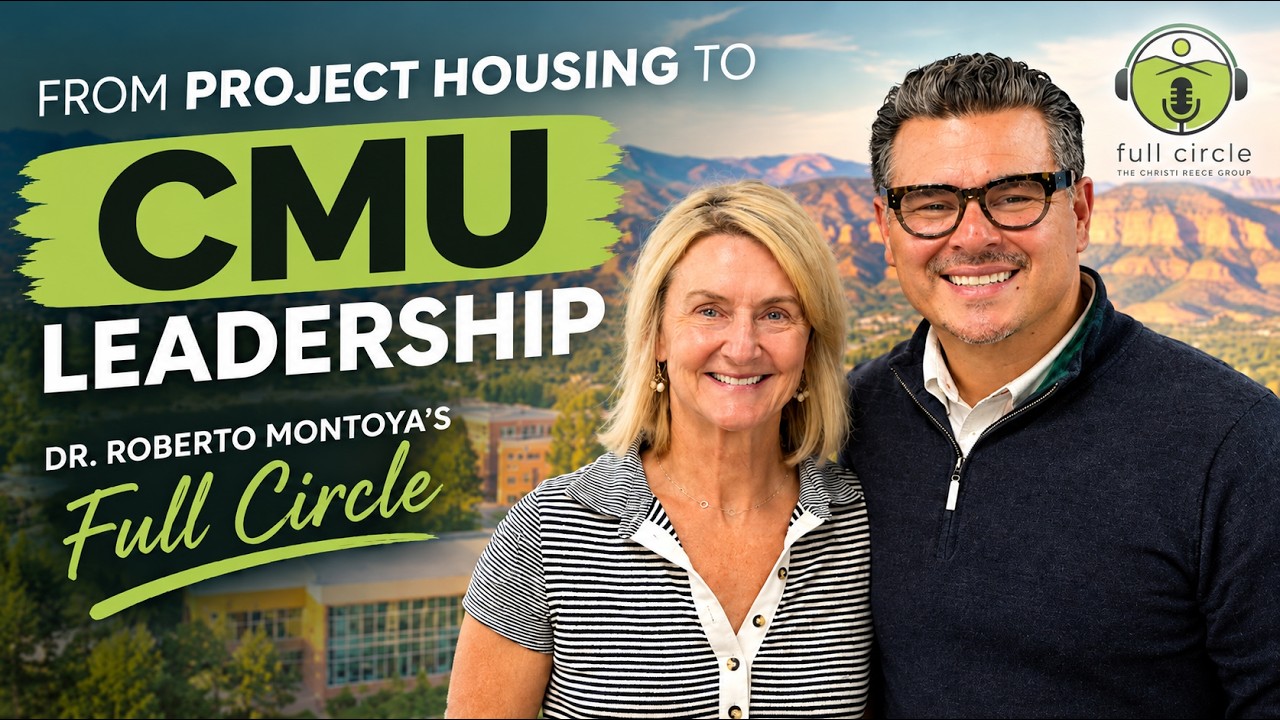
A Full Circle Journey: Dr. Roberto Montoya on Education, Opportunity, and Finding Purpose at Colorado Mesa University
How one Grand Valley leader’s journey from a working-class childhood to higher education leadership is helping shape the next generation of Mavericks.
Sometimes, the experiences that shape our future are the ones we never could have planned. For Roberto Montoya, Senior Vice President of Student Services at Colorado Mesa University (CMU), a career spanning corporate America, higher education, and Colorado state government ultimately brought him back to the place where his own educational journey began.
In the latest episode of The Full Circle Podcast, host Christi Reece sits down with Montoya to explore his remarkable path, the transformative power of education, and the importance of creating opportunities for students across Western Colorado.
His story is a reminder that success rarely happens in isolation. It takes hard work, supportive relationships, access to opportunity, and people who believe in us before we fully believe in ourselves.
From a Working-Class Childhood to a Life-Changing Education
Montoya grew up in Albuquerque, New Mexico, in a family that faced significant financial challenges. Raised primarily by his single mother, who worked as a cashier at Walgreens for 40 years, he witnessed firsthand what it meant to work tirelessly to provide for a family. His mother never graduated from high school, but she understood the importance of education and was determined to give her children opportunities she hadn't had herself. She also understood something equally valuable: the power of relationships. By building a strong network of people who could support her family, working additional jobs, and finding ways to make ends meet, she created a foundation that helped Montoya and his sister see possibilities beyond their immediate circumstances. Meanwhile, his extended family provided another important influence. His grandfather earned a college degree after serving in World War II, and his aunts and other relatives pursued impressive academic and professional careers. Their example exposed Montoya to a world of educational possibilities, even as he experienced the realities of growing up in poverty. It was a combination that shaped his outlook: his mother's work ethic, his family's educational legacy, and the understanding that opportunity means little unless you take action. For Montoya, attending college was never really a question of whether. It was a question of where.
Finding His Place at Colorado Mesa University
Montoya first attended what was then Mesa State College in 1995, arriving from Albuquerque to study political science and play football. He also served as student body president, establishing connections that would influence his life and career for decades.
Getting there, however, required someone to open a door. Before he enrolled, Montoya was invited to participate in a college recruitment weekend organized by then-recruitment leader Paul Jones, who later became CMU's president. Because his family couldn't afford to send him on college tours, the university helped cover the cost of the trip. That experience gave Montoya the opportunity to see himself on a college campus and imagine a future there. His transition wasn't easy. Coming from a high school where most students were Hispanic, Latino, Native American, or Black, arriving at a predominantly white institution was a significant cultural adjustment. He struggled with homesickness and even bought Greyhound tickets home twice, convinced he couldn't do it.
But he stayed. Looking back, Montoya describes Mesa State as giving him things he didn't know he needed. He built lasting friendships, encountered new perspectives, and learned to navigate unfamiliar environments. Those experiences helped him recognize an important truth: growth often happens when we're outside our comfort zones, even when we don't recognize it at the time. Today, that understanding informs how he approaches his work with CMU students who may be navigating unfamiliar territory themselves.
A Career That Took the Scenic Route
Montoya's professional journey wasn't a straight line from college to university leadership. In fact, the variety of his experiences is part of what makes his story so compelling. After earning his political science degree, he initially considered law school at Georgetown University. But when he learned he was going to become a father, his priorities changed. He chose to stay and build a life closer to home, and CMU created an opportunity for him to work in admissions. That position brought his journey full circle in an unexpected way. The student who had once needed help getting to campus was now traveling to meet prospective students and encouraging others to see themselves at Mesa State. From there, Montoya moved into the private sector, working in sales and marketing with The Hershey Company and later in marketing and project management with Red Robin. He experienced the challenges of corporate restructuring and the economic downturn of 2008, which eventually prompted him to reconsider his professional direction. Encouraged by his aunt, Margaret Montoya, a distinguished legal scholar and Harvard Law School graduate, he returned to school. He earned a master's degree from Regis University, followed by doctoral degrees in ethnic studies and education. He went on to teach, consult, and develop his leadership experience before becoming Colorado's first Chief Educational Equity Officer under Governor Jared Polis. In that role, he worked with public and private higher education institutions throughout the state, focusing on how to make educational experiences more responsive to the needs of Colorado students and families. Each chapter added a new perspective, from corporate strategy and relationship-building to teaching, public policy, and educational leadership. As Montoya explained during the conversation, those experiences made him a better practitioner and leader. His career demonstrated that the skills we develop in one field can often become valuable tools in another.
Why Colorado Mesa University Matters to Western Colorado
After more than two decades in the Denver area, Montoya returned to Grand Junction to serve as CMU's Senior Vice President of Student Services. The move wasn't simply a return to his alma mater. It was an opportunity to help another generation of students experience the same life-changing possibilities that shaped his own future. For Montoya, the decision felt right on every level. He described having alignment between his head, heart, and gut—a rare feeling that told him he was exactly where he was supposed to be.
That sense of purpose is especially meaningful given CMU's role in Western Colorado. According to Montoya, approximately half of CMU's students are first-generation college students, meaning they are the first in their families to attend college. The university also serves students from rural communities, lower-income households, and a wide range of backgrounds and life experiences.
For many families across the Western Slope, having a university in Grand Junction creates opportunities to pursue higher education without necessarily leaving the region they call home. Montoya believes students should have choices. Some may want to attend a university along Colorado's Front Range, while others want to remain connected to their families and communities in Western Colorado. Both paths should be possible. That philosophy is reflected in CMU's combination of academic programs and career-focused education through CMU Tech. Students can pursue technical training and certificates in fields such as welding and diesel mechanics while also having access to a traditional college experience. They may later choose to pursue a two-year degree or bachelor's degree, change direction, or return to school after gaining work experience. The goal is to create pathways that allow students to discover what works for them rather than forcing everyone into the same definition of success. For a region with diverse communities, industries, and career opportunities, that flexibility is an important resource.
Making College More Affordable and Accessible
One of the biggest questions facing students and families today is whether college is worth the investment. Montoya acknowledges that these questions are legitimate. A degree can open doors, but families also have to consider tuition, financial aid, housing, and the long-term burden of student debt. At CMU, he says, affordability is a priority. The university emphasizes merit scholarships and efforts to help students graduate with little to no debt whenever possible. The goal is to give graduates greater financial flexibility as they enter the workforce, start businesses, purchase homes, and build their futures. Accessibility also means helping students and families navigate a process that can feel overwhelming, particularly when no one in the family has gone through it before. From completing financial aid applications to understanding scholarship opportunities and choosing an academic pathway, the university has an opportunity to make the process more approachable. Housing is another important part of that equation. During the podcast, Montoya discussed the opening of Centennial Village, a 310-apartment development intended to provide additional on-campus housing options for third- and fourth-year students. These efforts reflect a broader understanding of student success: helping someone earn a degree requires more than providing classes. It also means recognizing and addressing the practical challenges that can prevent students from fully participating in college life.
Building a Campus Where Everyone Belongs
For Montoya, student services is about more than programs and policies. It's about listening. He takes the word students in his title seriously, emphasizing that his responsibility is to serve all students and remain responsive to their needs. That can mean meeting with student leaders, holding office hours, considering financial aid and scholarship strategies, or addressing everyday challenges such as campus parking that can affect a student's ability to get to class. It also means recognizing that belonging doesn't happen automatically.
Commuter students may have fewer opportunities to connect with classmates outside the classroom. Adult learners returning to school in their 40s, 50s, or 60s may have different needs from traditional college-age students. First-generation students may need additional guidance as they navigate unfamiliar systems. Each student brings a different perspective, and Montoya believes universities must actively create opportunities for those perspectives to be valued. He also emphasizes the importance of teaching students how to think, not what to believe. Encouraging curiosity, critical thinking, and respectful engagement with different viewpoints helps prepare students to participate in a complex world. For Montoya, the goal is a university where students can develop a genuine sense of belonging while being encouraged to ask questions, challenge assumptions, and continue learning.
What We Can Learn From the Generations Before Us
One of the most memorable moments in the conversation centers on Montoya's belief that when an elder dies, it's like a library burning down. It's a powerful way to describe the knowledge and lived experience that can disappear when we fail to connect with older generations. Grandparents and elders carry stories, lessons, and perspectives that can't always be found in books or classrooms. Their experiences can help younger generations better understand the world and see familiar challenges through a different lens. Montoya discussed an initiative called 3G, short for three generations, led by Sesame Street. The initiative brings together an elementary school student, a college-age student, and an older adult to watch and discuss shared material, creating opportunities for conversation and mutual learning. The concept reflects something important about education: learning doesn't happen only between a teacher and a student. It also happens between generations, across different experiences, and through the willingness to listen. Montoya sees these connections as an opportunity to address loneliness, strengthen relationships, and recognize the value that people of every age bring to a community. It's a perspective that feels particularly relevant in Western Colorado, where family ties, community involvement, and connections across generations are an important part of local life.
When Helping One Person Helps Everyone
Another concept Montoya explores is targeted universalism: the idea that addressing the specific barriers faced by some people can ultimately benefit everyone. He illustrates the concept with familiar examples. Closed captions may be designed to improve accessibility for people who are deaf or hard of hearing, but they also help people watching a program with unfamiliar accents or trying to catch every word. Ramps improve access for people with mobility challenges while also helping parents with strollers, travelers with luggage, and people recovering from injuries. The broader lesson is that when we design systems with people facing the greatest barriers in mind, the benefits often extend much further than we initially expect. At CMU, that thinking connects directly to the university's work with first-generation students and other populations who may encounter additional challenges when pursuing higher education. By creating better pathways, clearer processes, and more supportive environments, the university can help individual students succeed while strengthening families and communities for generations to come. As Montoya's own story demonstrates, the impact of education doesn't stop with one graduate. It can influence children, parents, future leaders, and entire communities.
A Community That Makes the Western Slope Special
As the conversation comes to a close, Montoya reflects on his return to Grand Junction and the welcome he and his family have received. Having recently purchased a home in the area, he speaks warmly about the generosity, kindness, and sense of community he has experienced on the Western Slope. It's a reminder that the Grand Valley's appeal extends beyond its landscapes and outdoor recreation. It's also about the people who make this place feel like home. Montoya shares the advice he gives his two sons each day: Be curious, be kind, and be great. He encourages them to be good friends, students, and listeners—to approach each day with curiosity and make a positive contribution, however small. It's simple advice, but it captures many of the themes woven throughout his story: the importance of relationships, the value of learning, and the responsibility we all share in helping others thrive. His return to Colorado Mesa University is a full-circle moment in the truest sense. The institution that once helped him imagine a different future is now the place where he works to help other students imagine—and build—theirs. And for Western Colorado, having leaders who understand both the challenges and the possibilities of education is an important part of the region's future.
Listen to the Full Conversation on The Full Circle Podcast
What does it take to turn opportunity into lasting impact? How can education change the trajectory of a family? And what makes a community a place where people truly feel they belong? In this episode of The Full Circle Podcast, Christi Reece and Roberto Montoya explore these questions through a candid conversation about family, education, leadership, and life on Colorado's Western Slope.
Listen to the episode and discover more stories about the people shaping Grand Junction and the communities we call home.
At The Christi Reece Group, we believe that knowing a place means understanding more than its real estate market. It means getting to know the people, institutions, businesses, and community connections that make Western Colorado special. Whether you're considering a move to Grand Junction, Fruita, Palisade, or somewhere else on the Western Slope, we're here to help you feel at home.
Reece Stanley
Managing Broker | Owner | CEO | REALTOR® | Grand Junction Real Estate - The Christi Reece Group
or another way